
Botswana
The invisible line between predator and prey
Impact
Peter Apps and Mpho Williart
10/8/2026
BioBoundary installs lion deterrent screening tests in Linyanti

For Mpho, the science serves a much older problem. ‘At its heart, the project is about finding a way for people and predators to share the same landscapes with fewer conflicts,’ he says. ‘For communities living alongside wildlife, losing livestock to predators can have significant economic and social consequences. For predators, these encounters can ultimately result in retaliatory killings. Finding ways to prevent these encounters before they occur could therefore benefit both sides.’
The work of turning that idea into something testable began in early August, when Peter Apps of Wild Entrust Africa flew into our Linyanti Wildlife Reserve to launch the first phase: isolating the actual chemical components of the artificial signals. Along with Mpho, he was also joined by Pitso Modimbura, Wilderness Ecological Monitor.
‘The artificial signals use the odours of components of lions’ scent marks and body odours, identified in the BioBoundary laboratory in Maun,’ Peter explains. ‘Reactions of wild predators to the test scents are recorded by camera traps that capture 20-second video clips when they detect an animal’s moving body heat. Test odours are emitted by slow-release dispenser tubes at a rate of micrograms per hour, barely detectable to the human nose even at close range, but strong enough to attract the interest and other reactions of animals. There is a scent-dispenser housing on each side of the road so that scent blows across the road regardless of wind direction, and the cameras are aimed to have the dispensers in the middle of their field of view, so that no predator can approach undetected.’
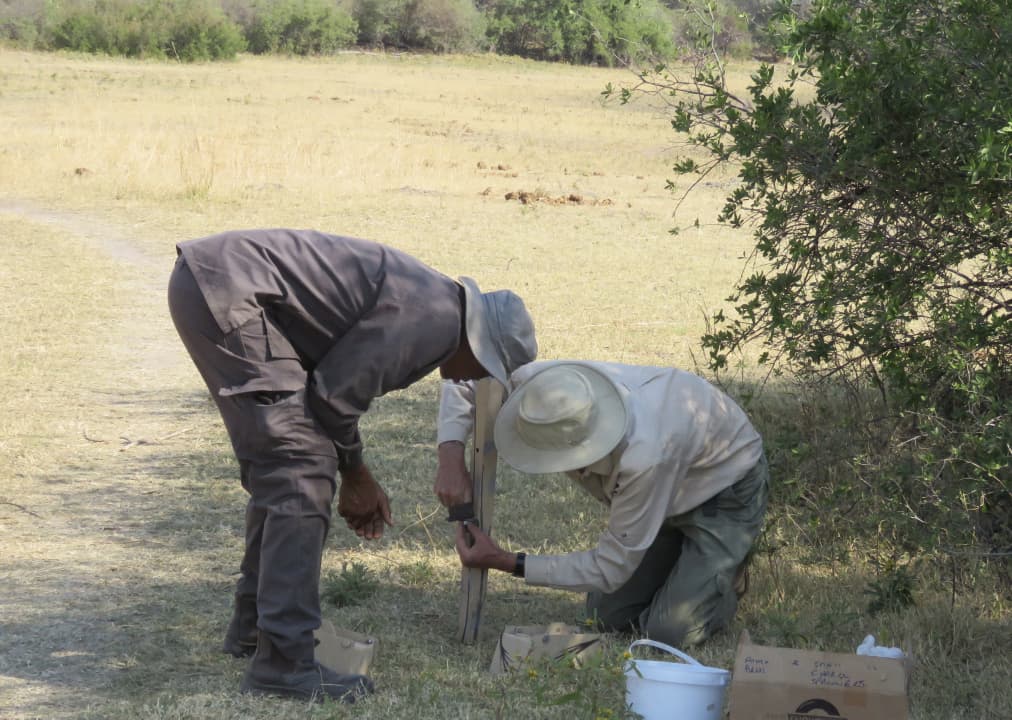
Lions sit at the centre of this round of testing for a specific reason – they’re a gap the earlier work couldn’t fill. ‘Lions are the primary target because they are a gap in the results of previous screening tests, which were done in livestock areas where lions are almost absent, but we will also capture the reactions of all the other species that live in the area,’ says Peter. ‘It would be no surprise to record prey species or other predators avoiding the odours. Lions are at the apex of apex predators, and a threat to everything else in the ecosystem. If we get those responses, we will follow up their potential as predator deterrents and for keeping herbivores out of crops and gardens.’
Getting the equipment into the ground turned out to be its own kind of education. ‘Pitso and Mpho got a crash course in setting up dual camera trap monitoring stations – the precision layouts and camera aim that ensure the maximum yield of high-quality video data – as well as upper-body workouts hammering the elephant-resistant camera poles into the ground,’ Peter recalls. ‘The camera traps are mounted on the poles in heavy duty steel boxes to protect them from elephants, hippos and spotted hyenas, and when we found that the brackets did not align or swivel properly, Pitso and Mpho got another lesson in an essential field skill: on-the-fly ingenuity and getting the job done no matter what!’
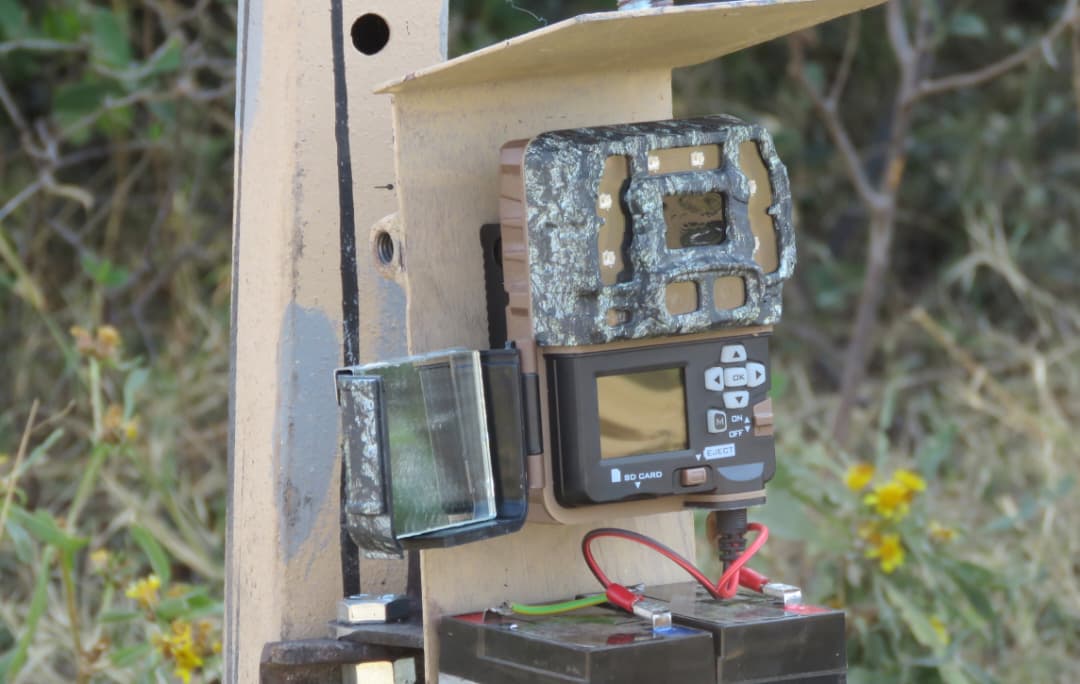
The clock, meanwhile, was unforgiving. ‘Time was tight. We needed to set up 10 testing stations with two camera traps and two scent dispensers at each station, within only a three-day window before other commitments called us away,’ says Peter. ‘Finding good spots for the testing stations took longer than actually setting up the equipment. The first requirement for a good site was a history of plenty of lion sightings by the Wilderness guides, and then, to get good video data on the reactions of wild animals to the synthetic odours we needed to set up on straight(ish) sections of road, with not too much leafy vegetation in the background that would move in the wind and trigger the cameras over and over again until their memory cards were full and their batteries empty. Such sites proved to be remarkably rare. Day two ended in the dark with us setting up by the light of flashlights, and we got the final site set up only on the morning of the third day.’
With the stations in place, the real waiting began. ‘For the first month the dispenser tubes remained empty while the animals got used to the equipment next to their paths, and their wariness towards anything new or unusual waned,’ Peter explains. ‘Putting scent in straight away would risk mistaking an animal’s fear of novelty for a reaction to repellent scent. Lions were indifferent from the start, spotted hyenas were wary and curious, and hippos were just curious. Long experience has shown that elephants casually knock down cameras and flatten the dispenser housings into the dirt and that is why everything is over-engineered, heavy-duty metalwork.’
By the second week of September, the acclimatisation period was over and the real test could begin. ‘The first of 10 test compounds went into the housings in the second week of September,’ says Peter. ‘Each compound will be tested for two weeks, which we expect to give us several encounters with lions, lots of spotted hyenas and enough leopards and brown hyenas.’
Watch this space.

More to discover

Wilderness Rwanda celebrates second group of CITW scholarship graduates
These 39 graduates are the second set of recipients of a CITW Rwanda scholarship, and hail from the ...
Read moreJosephine Bestic
28.10.2026
Children in the Wilderness celebrates World Conservation Day
Explore how Children in the Wilderness celebrated World Conservation Day 2026, inspiring young peopl...
Read moreJosephine Bestic
29.07.2026
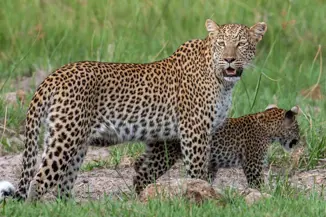
Every leopard has a story: Chitabe’s data-driven research project
Meet the remarkable leopards of Wilderness Chitabe. Explore how guides, researchers, and photographe...
Read moreIngrid Wood
24.06.2026
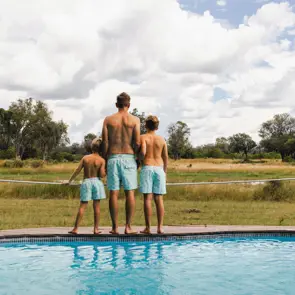
Matching father - son swim trunks from Love Brand & Co. & Wilderness
Wilderness and LOVE BRAND & Co. launch luxury swim shorts inspired by African wildlife and a shared ...
Read moreLeigh-Anne Nel
30.05.2026

International Literacy Day: Wilderness' Commitment to Education
This 8th September, Wilderness celebrates International Literacy Day and literacy's ability to forge...
Read moreTao Varty
08.09.2025
Let’s plan your next journey
Ready?
When we say we’re there every step of the way, we mean it, literally. From planning the perfect circuit, to private inter-camp transfers on Wilderness Air, and easing you through Customs. We’re with you on the ground, at your side, 24-7, from start to finish. Ready to take the road less travelled? Contact our Travel Designers to plan an unforgettable journey.